46 driver breadboarded. The mu-follower gyrator, the filament bias resistor array and the nice teflon UX5 socket from Jakeband. The filament bias resistor array is formed by 4 10Ω 20W dale wirewound resistors. These get very hot so probably need to think an alternative layout or further resistors in parallel:
The performance is very good. I just picked up a random 46 from my stock and biased it at 204V (which is the operating point in my design) achieving less than 0.05% at 10Vrms. Need to re-run this test to see how will perform at 70Vrms:
Month: December 2012
4-65a SE Amp: filament regulators
4-65a SE Amp: 46 Driver Gyrator
A day of PCB etching
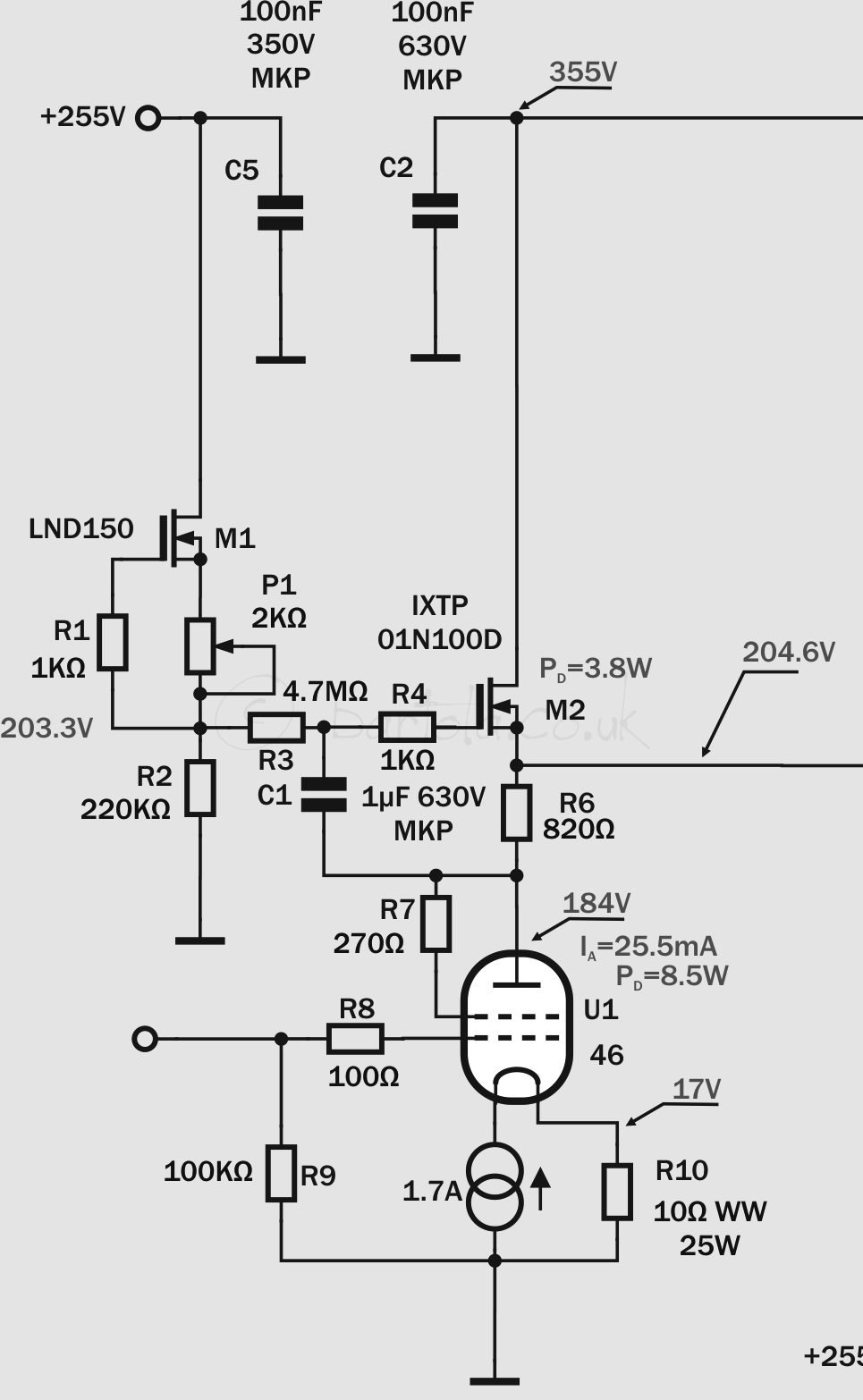
After a lot of work today in designing many PCBs, I finally got a pair of mu-follower MOSFET gyrators for the 46 driver stage. The driver has to provide very low impedance to operate the 4-65a output valve in class A2. The gyrator in mu-follower configuration will enable the right bias point as the amplifier is DC coupled as well as maximum signal (and current in A2) with minimum distortion.
Many don’t like sand at all in their amplifiers. I have a lot of experience with gyrators and CCS loads in pre-amps and drivers as well. I have to say that with MOSFETs gyrators the sound is really nice. For an A2 driver, not many options are available and the gyrator is a great choice for this job.
I built two PCBs (one per channel) and the circuit is the classic depletion-mode MOSFET gyrator based on the high-voltage IXTP01N100D. I guess that a DN2540 should work as well here but I’ve been saving the IXYS for this occasion. The reference voltage for the anode bias point is provided by the CCS formed by M1 (LND150) which provides a higher impedance in AC improving the frequency response of the gyrator.
The 46 is operating in triode-mode and filament bias with a Rod Coleman filament regulator. R6 is approximately 1/gm and output voltage is set by P1 to achieve the 4-65a bias point as the amplifier has stacked power supplies given coupling is DC, so no capacitors in the path to the grid.
Next: some tests on these gyrators and the filament boards…
4-65a SE Amp: 46 Driver Raw Supply
One more filament raw supply completed today: the 46 driver in filament bias. This driver stage requires 26V @ 1.7A due to the filament bias requirements. Yes, nearly 45W in the filament but will provide a fantastic driver stage with the 46 triode-strapped and filament bias to avoid any nasty capacitor in the signal path.
The power supply design is very simple and follows Rod Coleman’s recommendations for the DHT filament regulators. One drawback in this version, compared to the output stage raw supply, is that this will be pure capacitor filtering with no help of a choke to reduce the input current pulses.
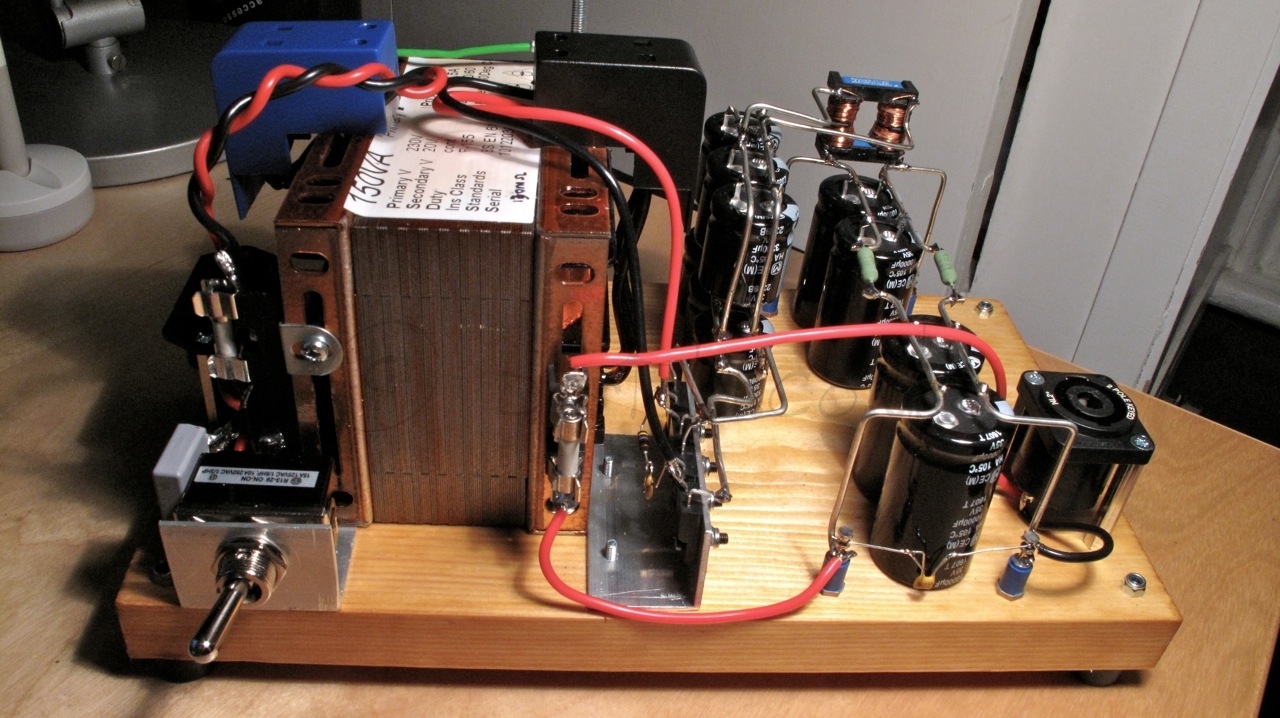
The split-bobbin 150VA transformer provides sufficient current for the capacitor input filtering stage. The DSB10I45 (Schottky 45V/10A) bridge is also mounted on a “L” shape aluminium piece.
The capacitor arrays are soldered to a thick bare wire which provides structure and simplifies connections between components: 
I was initially concerned that without shielding the high-current pulses may introduce some noise in the output as F2 fuse is mounted on the transformer frame so the wire is routed back and forward to that point. Reality is that the hum level is very low. I measured 16.4mV peak-to-peak at full load.
4-65a filament supply mono block
Today made more progress as managed to build one of the 4-65a raw filament supplies. They weigh a ton so decided to build monoblocks for all filament power supplies as well as the main amp.
The power supply is built on a piece of wood. This is a fast method for breadboarding the amp which provides fantastic results. I’m using PTFE sleeved wire for the first time. This is rated 600V and 10A, sufficient for the requirements here.
The common-mode choke is built under the capacitor arrays to reduce wire length and optimise space use.
The choke and 200VA transformers are bolted directly to the board.

The Schottky rectifier bridge is mounted on an 4mm alumminium angle which is primarily used as heat sink and also the solid structure helps to mount the first capacitor array very close to the bridge.
Tested the supply with a dummy load of 3R3 50W. Ripple is only 53mVpp which will be dramatically reduced by the Rod Coleman filament regulator.
Edit (28th December 2012)
Just made a minor adjustment of the output voltage by the addition of R1 and R2 and fuse F1 was increased to 2A to avoid blowing it at full load when switched on:
4-65a filament supply
One of the good things about Christmas is that I always managed to get some proper time for working on my projects. This year is devoted to my belated project: 4-65A SE amplifier. We bid farewell to our family guests so had this evening a bit of time to start preparing the filament raw supply for the 4-65A.
This will be a heavyweight amplifier. Too much iron, but 100% DHT and no capacitor in the signal path, a promising design.
A couple of hours were sufficient to prepare some of the key components: a pair of common-mode chokes winded on ferrite rings, capacitor arrays and a Schottky bridge mounted on an aluminium sink:
The raw filament supply circuit follows the standard design recommended by Rod Coleman to use the filament regulator boards. I managed to get a nice pair of 10mH@3.5A chokes made by JMS transformers which is the same company that provides the custom-made split bobbin transformers:
The 10mH choke will help reducing the current pulses and the input capacitance, which is less than 3mF. This circuit will provide 12V @ 3.5A with a ripple current of 31mV peak to peak maximum.
4P1L PSE or 6C4C
Andy Evans and myself have been experimenting with the 4P1L extensively. No one will argue that the 4P1L is a cracking valve. It’s very linear, has low anode resistance and its filament is not demanding, so it can be easily used in filament bias. Similarly, pairs are very easy to match, is still cheap and a pair of them can performa as well as a 2A3 at a fraction of its cost.
In one of the listening tests we did at Andy’s I found that a 100% 4P1L system (i.e. pre-amp, driver and output valve) had something missing in its tone. Perhaps is the clarity and neutrality of the 4P1L, but definitely I’d add a warmer valve somewhere in the signal path.
I’ve been toying with the idea of upgrading my 45 at some point or at least provide some way of testing several combinations of output valves. To me, I’d rather implement filament bias but in most of the cases is not possible due to the filament demands. 4P1L in PSE can be easily achieved in filament bias. I did some tests recently, with outstanding results. Ultra-path could be an option, but of course will demand more attention to the HT supply filtering. Fixed bias on the other hand, proved to be very effective, but yet requires a low noise bias. Rod Coleman suggested recently to use his filament regulator boards to provide a very low noise and stable bias by means of providing a stable and low noise current through a bias resistor. A very simple and neat concept which is shown in my early design for this SE or PSE amplifier:
4P1L as a driver is a great choice. Firstly, it can be easily implemented with filament bias, so no nasty capacitors are required. I’ve got a pair of LL1671/20mA which can provide a great 1:1 coupling whilst reducing the HT requirements of the driver stage. 4P1L running at Ia=20mA, Va=243V, Vgk=-17V can drive easily the 6C4C into clipping. R5 performs as the bias resistor for the output valve. The CCS3 regulator is set to about 0.95mA to develop about -44V across the resistor. As there will be no DC current flowing across the secondary there will be no voltage drop and the valve will be biased accordingly. The current meter will allow us to track any bias drift and re-adjust when needed. The 6C4C will be biased at Ia=60mA and Vak=250V. The output transformer is the LL1623/60mA which can be configured for multiple impedance requirements: 5K6, 3K and 1K6. This will allow me some flexibility in the output stage when testing other combinations.
The same circuit can be easily adjusted to fit the 4P1L PSE output stage:
A pair of 4P1L can replace the 6C4C biased at Vak=250V, Ia=30mA and Vgk=-20V. The bias resistor (R7) has to be changed to 20K to allow the 20V bias voltage requirement. No further changes to the circuit are needed with the exception of the CCS2 that needs to be adjusted to fit the 1.3A (2x650mA) required by the filaments.
Merry Christmas!
Getting in the mood
Globe meets ST :-)
Bench VARIAC (preventing disasters)
Have you ever built a HT power supply for your amplifier, turned it on and experienced some smoke? Well if you haven’t you either have been lucky or too meticulous when testing. Either way, there is always good to have a safe mechanism to test our power supplies, amplifier, etc. Some devices are too precious to take any risk when doing the first tests.
A Variac is a perfect device for your tests. Is actually an autotransformer for the mains. As it’s an autotransformer there is only one winding therefore there will be no isolation between mains and the output. There are many Variacs in the market. As I wanted to add current and voltage meters (see below), I decided to build my own. There are some cost benefits as well and you can build this circuit very easily.
My choice was the Indian Ravistat 2F-1: an open type, single-phase variable transformer, rated at 240V@2A. This variac gives a continuously variable alternating current (a.c.) output voltage, has a solid construction, high efficiency/excellent regulation and no waveform distortion with smooth linear output & overload capacity.
A 2A Variac will provide at least 1.8A @ 240V (432W). This is more that what I need for my testing purposes. You may want to go for a higher power version depending on your specific requirements.
The idea of adding the current meter is very simple, but effective. The current meter will give you an early warning that something may be going wrong if the current surge is more than expected. In that case you can stop and dial down the voltage to avoid a problem.
I bought a pair of cheap Chinese AC meters. I built the bench Variac using the remainder of a floor plank which I applied a cover of button polish and clear wax. Using aluminium and standoffs I placed the heavy Variac, added the switch and mains connectors. I have binding posts for tests as well as a proper AC outlet:
Now, it’s time to progress with the amp building and start using this device when testing!
Cheers,
Ale