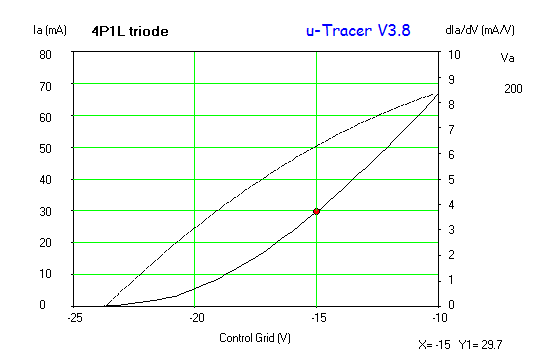
4P1L model improved

 Improving the DHT model in A2

After playing for some time with the uTracer, I found that the tracer wasn’t measuring accurately A2 curves. Ronald clearly advised me (as explained on his site) that uTracer wasn’t designed for this purpose although there was a great trick to use the screen driver to generate the A2 curves and also measure grid current. Measuring grid current is key in A2 mode so a better grid current model can be derived to better simulate the non-linear and low impedance behavior of the grid in positive bias.

My incarnation of the uTracer is not neat. I’m using my existing analogue curve tracer. As shown in the pictures below, my current tracer have a plethora of sockets and just adding right jumper cables for anode, cathode, screen and grid connectors will still give me the flexibility I had with my analogue tracer

The process of generating the A2 curves (and SPICE model) starts by plotting the normal curves. The uTracer is great for this. Then you have to overlay the A2 curves in Excel (or whatever tool you prefer) to combine both set of curves.
Continue reading “4P1L model improved”

4P1L: Tracing A2 curves (first test)

Just finished the digital tracer project uTracer V3. Did some further tests this morning, now with my favourite DHT: 4P1L.

Started with a well known bias point for triode-strapped operation:

4P1L Va=200V Continue reading “4P1L: Tracing A2 curves (first test)”

uTracer up and running

After a stupid mistake which blew the PIC, I finished today my version of the uTracer. A quick trace of an CX-226 RCA Radiotron can be seen below. This is an incredible digital tester. I need to test it properly and do some comparisons against my analogue tracer, but as everyone would expect,the digital tracer has superior capabilities in terms of data manipulation and representation.

Highly recommended. Ronald provides a sterling service and specially when I damaged the PIC and send me a replacement at no cost!

More to come shortly…cx226 RCA test

4-65A SE Amp: first tweaks

As discussed previously, I replaced the gyrator’s polypropylene caps with better ones I had at hand which are 1uF 450Vdc Mundorf Mcap EVO Silver Gold Oil Cap (EVOSGO-080). I should look at lower value. A 220nF or even 100nF one should provide a 1Hz -3dB point with the 4M7 resistor. Anyway, the sound is a tad better in the bass I would say. Nice upgrade but should listen to it more to find what other changes has this capacitor made to the amp:

Lenco turntable (Part II)

Great thing about bank holiday weekends is that you have more time to work on your projects! At least I had this time round.

After doing the initial calibration to the Lenco idler mechanism, I got the turntable finally assembled on the new plinth. It runs very quiet and smoothly despite having not dampened the idler wheeler  as recommended in the Lenco Heaven forum. I need to look into it but so far the turntable runs really quiet.

The arm board is a bit lower than it needs to probably. I can adjust the VTA with the micrometer but I should look at raising it to allow the arm to be rotated to the right for best placement. The micrometer is preventing this to happen. Will refine later.

Ok, impressions so far after all this work then. I did many upgrades this time to my system so it is hard to quantify which part contributed the most to the sound improvement. Overall tone and clarity has improved. I suppose that the heavy plinth makes a big difference to the bass clarity. The overall tone improvement and detail is quite likely to be the Audiomods tone arm as well as using the Clearaudio Virtuoso Wood MM cartridge that Tony kindly give me to try.

Lenco turntable (part I)

A rare occasion in my hi-fi life is too see me switching from electronics to basic mechanics. I’m not either good with woodworking or mechanics :). Either way, the GL75 rebuild is coming along quite fast. I sealed the original arm holes in the top plate and painted it yesterday. Today, I spent all morning waxing the plinth. The afternoon was devoted to rebuilding the Lenco turntable mechanism and testing the re-lubed motor and spindle. I still need to do further calibration, but so far so good.

Here are some pictures of the building steps:

Barry French’s 26 DHT preamp

26 DHT Preamp (by Barry French)

After owning several high quality pre-amps & modifying some of them to some degree or another, I decided to have a go at building a top quality unit, so here goes first I needed to build the power supplies for filaments & B+ in a separate case, I already had some idea of the look & design that I wanted to follow, so I sourced the following components from these suppliers:

Continue reading “Barry French’s 26 DHT preamp”